E pluribus unum
To celebrate the USA's 250th anniversary of independence, we will lead you through a rare special version of the "Declaration of Independence - The B'nal B'rith Version" and see how Jewish immigrants claimed the Declaration and embodied the American value "E pluribus unum".
E pluribus unum is a Latin phrase that translates to "out of many, one" or "one out of many". It is a traditional motto of the United States, famously featured on the Great Seal of the United States and on most U.S. coins and one-dollar bills.

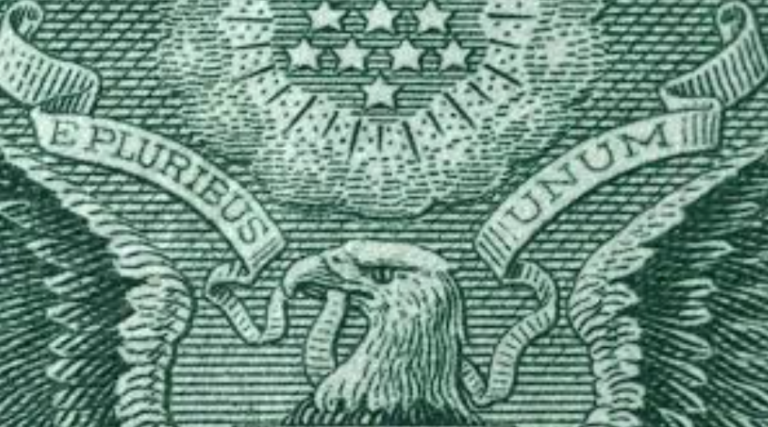
The First Committee (1776): On July 4, 1776, the Continental Congress appointed Benjamin Franklin, Thomas Jefferson, and John Adams to create a national seal. Recognizing they lacked design expertise, the trio hired Du Simitière as a consultant.
Cultural Evolution
Over the years, the meaning of e pluribus unum has evolved to reflect the diversity of the American people. Today, it is widely used to describe how a population made up of immigrants from diverse backgrounds, cultures, and races comes together to form one cohesive country..
How Jewish immigrants claimed the Declaration
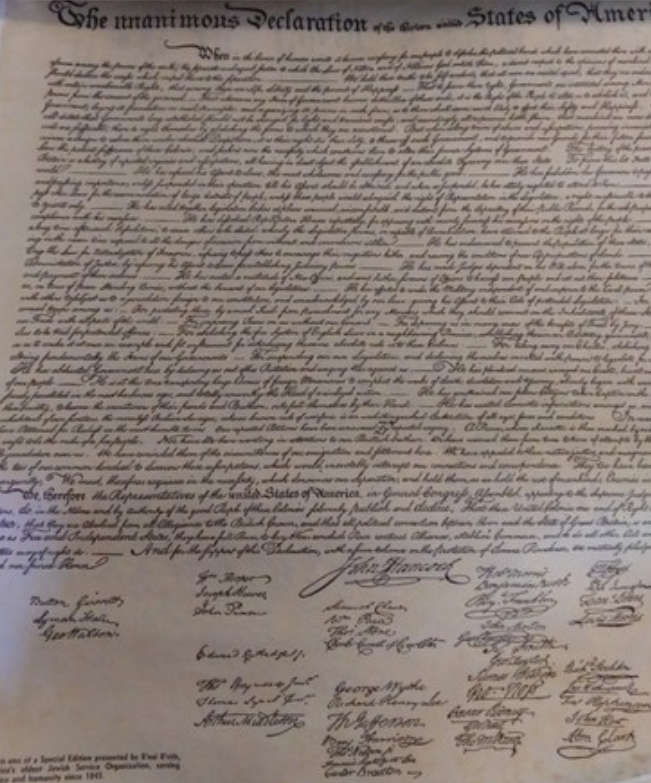
Declaration of Independence
The B'nal B'rith Version
Collection of NESM
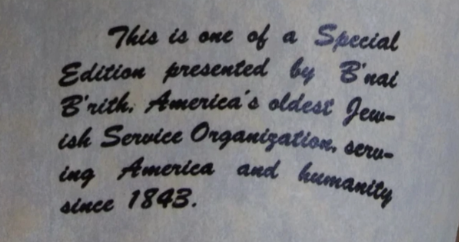
B'nai B'rith International is one of the oldest and most widely known Jewish service organizations in the world. Founded in New York in 1843, its name translates to "Children of the Covenant" in Hebrew. Today, it operates in nearly 60 countries, focusing on community service, human rights advocacy, and combating antisemitism.
It is easier to understand the key concept of E pluribus unum through the words from J. Hector St. John de Crèvecœur (French-American immigrant writer):
"In this great crucible, those who were consumed and persecuted by Europe or Asia will be reshaped through the flames of freedom."
This quote perfectly captures one of the most core concepts in early American immigrant history: "The Melting Pot" and the birth of the "New American." This line is derived from Crèvecœur's famous 1782 book, Letters from an American Farmer. In this work, he famously asked the foundational question: "What then is the American, this new man?"
Key Concept Breakdown
- A Sanctuary from Oppression: By mentioning those "persecuted by Europe or Asia," he highlights that most early immigrants came to escape the rigid class systems, religious persecution, and poverty of the Old World.
- The Transformative Power of Freedom: He believed that America's "flames of freedom" (accessible land, fair laws, and autonomy) possessed a powerful ability to transform individuals.
- The Birth of a New Nation: In this crucible, immigrants left behind their old national prejudices and identities. They fused together into a brand-new race of men, adopting new ideas and a new way of life.
Crèvecœur's perspective laid the groundwork for America's national identity as a "Land of Opportunity," emphasizing a world in which anyone could change their destiny and achieve rebirth through hard work. Today, it's not just a core value of America; it's already spread to the world and become the foundation for equal human rights and freedom.
During the USA's 250th anniversary of independence, NESM made a podcast to celebrate and explore the "B'nal B'rith Version Declaration of Independence", showing the beauity of "E pluribus unum" and how Jewish immigrants claimed it in the United States of America.

Declaration of Independence
The Declaration of Independence is the foundational U.S. document, adopted by the Continental Congress on July 4, 1776, formally announcing the thirteen American colonies' separation from Great Britain, asserting natural rights (Life, Liberty, Pursuit of Happiness) and the right to self-governance, and outlining grievances against the King. Primarily drafted by Thomas Jefferson, it declared the colonies "Free and Independent States," justified revolution, and sought international recognition, making July 4th America's Independence Day.

July 2026